
What Happens After You Accept a Cash Offer on Your House?
Understanding what happens after accepting a cash offer on a house can make the period between saying “yes” to an offer and actually receiving your proceeds much easier to navigate.
Accepting the offer is an important milestone, but the sale isn’t finished yet.
There may still be a purchase agreement to finalize, title work to complete, property information to review, closing requirements to address, and documents to sign before ownership officially changes hands.
One major difference between a cash sale and a traditionally financed transaction is that the buyer isn’t relying on mortgage approval to purchase the property. That can remove lender underwriting and financing contingencies from the equation, depending on the contract.
But cash doesn’t necessarily mean instant.
Even an all-cash sale still involves a real property transfer, and important steps generally happen between accepting the offer and closing.
Whether you’re relocating, dealing with an inherited property, selling a rental, facing expensive repairs, or simply trying to sell your house fast, knowing what happens next can help you ask better questions and recognize potential delays before they become surprises.
Here’s what homeowners should know.
What Happens After Accepting a Cash Offer on a House?
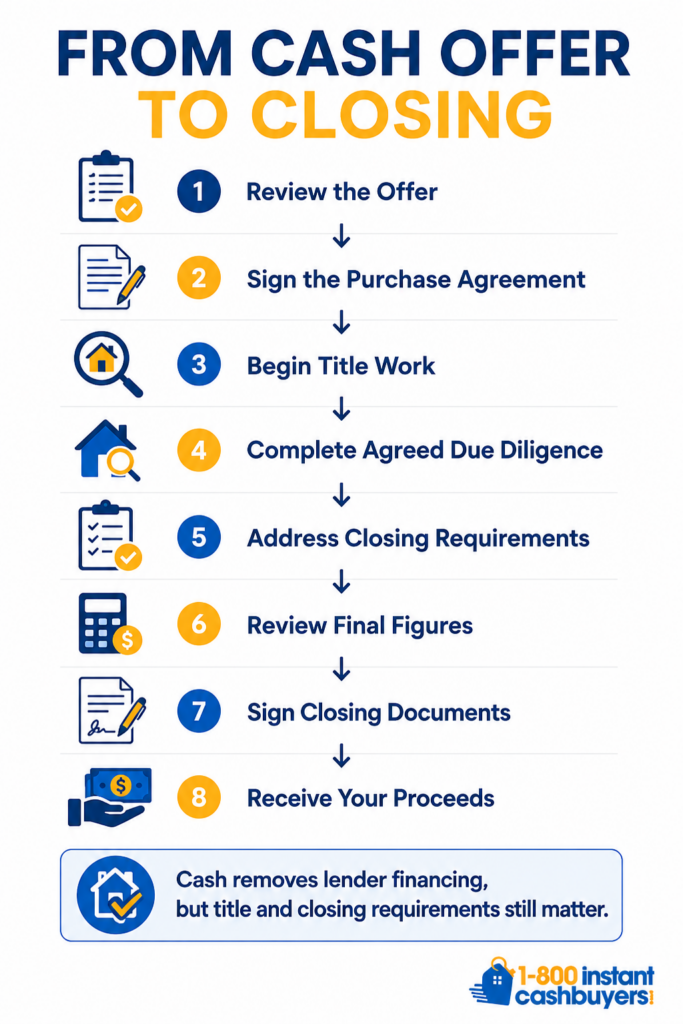
Although every transaction is different, a cash home sale will generally move through several stages.
| Stage | What Typically Happens |
|---|---|
| 1. Accept the offer | Seller agrees to proposed price and terms |
| 2. Sign the agreement | Purchase terms are documented |
| 3. Begin closing | Transaction moves into title and closing processing |
| 4. Review title | Ownership and recorded title matters are examined |
| 5. Complete due diligence | Any agreed property review takes place |
| 6. Address issues | Outstanding closing requirements are handled |
| 7. Prepare documents | Final figures and documents are prepared |
| 8. Close | Required documents are signed |
| 9. Disburse funds | Seller receives applicable net proceeds |
The exact sequence and timing depend on the contract, property, title history, closing provider, and circumstances of the transaction.
Let’s look at each stage.
Step 1: Make Sure You Understand the Offer
Before focusing on closing, make sure you understand exactly what you accepted.
A cash offer isn’t simply a dollar amount.
Two buyers could offer similar prices while proposing very different terms.
Consider:
- The purchase price
- Proposed closing date
- Earnest money or deposit
- Inspection rights
- Due diligence
- Contingencies
- Closing costs
- Property condition requirements
- Cancellation provisions
- Circumstances that could affect the purchase price
This is why the highest offer isn’t automatically the best offer.
Florida Realtors’ seller guidance similarly notes that sellers evaluating multiple offers may need to consider factors such as price, closing timing, and whether an offer is cash rather than looking at price alone.
If you haven’t signed yet and you’re comparing companies, read How to Compare Cash Home Buyers in Florida Without Getting Lowballed.
Step 2: Review and Sign the Purchase Agreement
Once both sides decide to move forward, the terms are documented in the purchase agreement.
This is one of the most important documents in the transaction.
It may address:
- Purchase price
- Property being sold
- Closing date
- Deposit
- Due diligence
- Inspection rights
- Property condition
- Closing expenses
- Title requirements
- Contingencies
- Default provisions
- Cancellation rights
Don’t assume all cash purchase agreements are identical.
They’re not.
A homeowner who needs to sell a house fast may naturally want to get the paperwork completed quickly, but speed shouldn’t replace understanding.
Read the agreement carefully.
If something isn’t clear, ask about it before signing.
For questions about your legal rights or obligations under a purchase contract, consult an appropriately qualified real estate attorney.
The Florida Bar advises consumers that the purchase contract and closing documents are important parts of a real estate transaction and notes that closing requires satisfying contractual obligations and title requirements.
Step 3: The Transaction Moves Toward Closing
Once the agreement is executed, the transaction generally moves into the closing process.
Depending on the location and transaction, a title company, attorney, settlement provider, or other closing professional may become involved.
The process can involve:
- Gathering property information
- Reviewing title
- Requesting mortgage payoff information
- Preparing transaction documents
- Calculating financial figures
- Coordinating signatures
- Handling funds
- Recording applicable documents
This explains why “cash” and “instant” aren’t necessarily the same thing.
The buyer may already have the money available, but the property still has to move through the required transaction process.
Florida Realtors also identifies the period between signing a purchase agreement and closing as a distinct part of the real estate process involving several potential steps.
Step 4: Title Work Is Completed
Title is one of the most important pieces of a real estate transaction.
A title review can identify issues involving ownership or recorded interests affecting the property.
Depending on the circumstances, these could include:
- Existing mortgages
- Liens
- Judgments
- Ownership discrepancies
- Unpaid property-related obligations
- Probate matters
- HOA-related issues
- Other recorded interests
Discovering an issue doesn’t automatically mean the transaction is dead.
Some issues can potentially be addressed as part of the closing process.
Others may require additional documentation or time.
This is also one reason two cash transactions can have very different closing timelines.
Can You Sell a House If You Still Have a Mortgage?
In many circumstances, yes.
Having an outstanding mortgage doesn’t inherently mean you have to pay the entire loan off out of pocket before putting the property under contract.
Mortgage payoff information can be obtained as part of the closing process.
Imagine, purely for illustration, that a homeowner sells a property for $300,000 and has an outstanding mortgage payoff of $175,000.
The seller generally wouldn’t receive the entire $300,000 while continuing to owe the old mortgage.
Instead, the closing figures would account for the mortgage payoff along with other applicable items.
What remains after applicable obligations and transaction expenses is the seller’s net proceeds.
Actual figures vary from transaction to transaction.
What If There Is a Lien on the House?
A title review may uncover a lien or another recorded claim against the property.
Some homeowners already know about these issues. Others discover them during the selling process.
Depending on the type of lien and circumstances, it may need to be satisfied or otherwise addressed in connection with the sale.
The important thing is not to immediately assume:
“I can’t sell my house.”
First determine exactly what was discovered and what is required to resolve it.
Step 5: The Buyer Completes Any Agreed Due Diligence
A cash purchase eliminates the need for the buyer to obtain traditional mortgage financing, but that doesn’t automatically eliminate due diligence.
The contract controls what happens here.
Depending on the agreement, the buyer might review:
- Property condition
- Needed repairs
- Occupancy
- Property records
- Permits
- HOA information
- Utilities
- Access
- Other property-specific matters
Some cash buyers purchase homes in their existing condition.
That can be useful for homeowners who don’t want to spend additional time or money renovating before selling.
However, homeowners should still understand exactly what inspection or due-diligence rights the contract gives the buyer.
Does Selling As-Is Mean There Is No Inspection?
Not necessarily.
This is a common source of confusion.
Selling as-is generally means the seller isn’t agreeing to make specified repairs or improvements before closing.
It doesn’t automatically mean the buyer has no right to evaluate the property’s condition.
The exact rights of each party depend on the contract.
This distinction can be especially relevant when selling a home with:
- An older roof
- Water damage
- HVAC problems
- Plumbing issues
- Electrical concerns
- Deferred maintenance
- Cosmetic damage
- Major renovation needs
A cash buyer may consider those conditions when calculating an offer rather than asking the homeowner to renovate first.
Want to understand that calculation?
Read How Cash Home Buyers Really Determine What Your House Is Worth.
Florida Realtors’ consumer resources also distinguish the meaning of an “as is” sale from questions surrounding home inspections, which is another reason sellers should understand the actual contract terms rather than relying only on the phrase “as-is.”

Step 6: Outstanding Issues Are Addressed
This is where the timeline can vary considerably.
A property with straightforward ownership and no significant title issues may move through the process relatively smoothly.
Another transaction might require additional work because of:
- Liens
- Probate
- Multiple owners
- Mortgage payoff issues
- HOA matters
- Judgments
- Missing documents
- Title defects
This is why homeowners should be cautious about interpreting advertisements such as “close in seven days” as guarantees for every property.
A fast closing may absolutely be possible in some circumstances.
But the property’s actual situation matters.
A better question for a buyer is:
“Is there anything about my property or title situation that could prevent us from closing on the proposed date?”
That’s far more useful than simply asking whether they can close fast.
Step 7: Review the Final Closing Figures
As closing approaches, the financial details of the transaction become clearer.
Depending on the sale, closing figures may include:
- Purchase price
- Mortgage payoff
- Taxes
- Liens or authorized payoffs
- Applicable closing expenses
- Credits
- Prorations
- Other transaction-specific items
The Florida Bar notes that a proposed settlement statement can show financial terms including credits, debits, prorations, closing costs, and other applicable fees.
That brings us to an important distinction.
Cash Offer vs. Net Proceeds
The cash offer and the amount you ultimately receive aren’t necessarily identical.
Here’s a hypothetical example:
| Item | Example |
|---|---|
| Purchase Price | $300,000 |
| Mortgage Payoff | $175,000 |
| Other Applicable Closing Items | $5,000 |
| Illustrative Net Proceeds | $120,000 |
This is only an example and isn’t intended to represent the costs or proceeds of a specific transaction.
Before closing, review the figures carefully.
If you don’t understand a deduction, ask what it is.
Step 8: Closing Day
Closing is when the transaction reaches its final stage.
The necessary documents are executed, applicable funds are handled, and ownership can be transferred according to the contract and closing requirements.
Before signing, verify:
- Your name is correct.
- The property information is correct.
- The purchase price matches your agreement.
- Expected payoffs are accurate.
- You understand the financial figures.
- You understand the documents you’re signing.
You don’t need to rush through a document simply because you’re at the closing table.
If something looks unfamiliar, ask.
Step 9: When Does the Seller Get Paid?
This is usually the part sellers are waiting for.
When do I actually get the money?
The timing of disbursement depends on the closing process and circumstances of the transaction.
Once the sale has properly closed and the applicable requirements for disbursement have been satisfied, the seller receives the net proceeds according to the closing arrangement.
Before closing, ask:
“When should I expect my proceeds and how will they be delivered?”
Your closing professional can give you an answer based on your actual transaction rather than a generic estimate found online.
Also be careful with wiring instructions. The Florida Bar specifically warns that real estate wire fraud is a serious concern and recommends independently verifying wiring instructions.
How Long Does a Cash Home Sale Take?
There isn’t one timeline that applies to every cash transaction.
A genuine cash purchase can remove several steps associated with mortgage financing, including lender underwriting.
That can potentially make the transaction faster.
But cash doesn’t eliminate:
- Title work
- Contractual due diligence
- Ownership issues
- Documentation
- Liens
- Probate matters
- Closing preparation
A straightforward property can therefore move much faster than a complicated one.
If your goal is to sell your house fast, don’t evaluate a buyer only by the shortest advertised timeline.
Instead ask:
“What could realistically delay this particular transaction?”
The answer tells you much more.
What Can Delay a Cash Home Closing?
| Issue | Potential Effect |
|---|---|
| Clear title | May support a smoother process |
| Existing mortgage | Payoff information may be needed |
| Lien | May require resolution |
| Probate | Additional documentation may be required |
| Multiple owners | Required parties may need to participate |
| HOA issue | Information or balances may need review |
| Due diligence | Timing depends on contract |
| Title defect | May require additional work |
The takeaway is straightforward:
Cash can remove financing delays, but it doesn’t remove every step involved in selling real estate.
How to Protect Yourself During a Cash Home Sale
Wanting a faster sale doesn’t mean you should skip basic due diligence.
Before closing:
- Understand what you signed.
- Know whether the buyer has contingencies.
- Ask whether the offer can change.
- Understand the due-diligence period.
- Know who is purchasing the property.
- Understand who is handling closing.
- Review your closing figures.
- Keep copies of signed documents.
- Verify payment and wiring instructions independently.
- Ask questions whenever something isn’t clear.
Research the buyer as well.
If you’re still evaluating whether a company is trustworthy, read Are Cash Home Buyers Legit? How to Spot Reputable Companies and Avoid Scams.
What Should You Compare Before Accepting a Cash Offer?
Before accepting, consider the whole transaction rather than only the headline purchase price.
Ask yourself:
What will I actually receive?
How certain is the closing?
Are there contingencies?
Can the offer change after an inspection?
Who pays which closing expenses?
Does the timeline work for me?
Do I understand the agreement?
Has the buyer communicated clearly?
A slightly lower offer with stronger terms could potentially be more attractive to a particular seller than a higher offer containing conditions they aren’t comfortable with.
There’s no universally “best” offer.
There’s an offer that best fits the homeowner’s priorities.
Helpful Independent Resources for Homeowners
For more information about real estate transactions and closing, homeowners can review independent educational resources rather than relying solely on information from companies purchasing properties.
Florida Realtors: Steps Between Signing and Closing provides additional information about what happens during the period between a purchase agreement and closing.
Florida Bar Consumer Guide to Real Estate Transactions discusses purchase contracts, title, deeds, closing, settlement statements, and other transaction considerations.
Florida Realtors: Navigating Multiple Offers provides additional consumer information for homeowners comparing different offers.
Frequently Asked Questions
What happens after accepting a cash offer on a house?
After accepting a cash offer, the transaction generally proceeds through the purchase agreement, title and closing processing, any agreed due diligence, preparation of final documents, closing, and disbursement of applicable seller proceeds.
How long does it take to close after accepting a cash offer?
There is no universal timeline. A cash transaction may avoid mortgage underwriting delays, but title issues, liens, probate, due diligence, documentation, and other circumstances can affect closing.
Can a cash buyer change the offer after I accept?
It depends on the contract and circumstances. Homeowners should understand any inspection, due-diligence, contingency, or cancellation provisions before signing.
Can a cash buyer back out?
The answer depends on the purchase agreement and any applicable contractual rights or contingencies.
Can I sell for cash if I still owe money on my mortgage?
An outstanding mortgage doesn’t necessarily prevent a sale. Mortgage payoff information can generally be addressed as part of the closing process.
Can I sell my house as-is for cash?
Many cash buyers purchase homes in their current condition. However, the exact meaning of an as-is sale and the buyer’s inspection rights depend on the contract.
Does a cash sale still involve title work?
Cash transactions commonly involve title review even though there is no mortgage lender.
Does a cash buyer need an appraisal?
A cash buyer isn’t relying on a mortgage lender that requires a lender appraisal. However, buyers may use their own methods to evaluate property value.
When does a seller receive the money?
The timing depends on the closing and disbursement process. Ask the closing professional handling your transaction when and how proceeds will be delivered.
Is a cash offer always better than a financed offer?
Not necessarily. Price, contingencies, timing, costs, certainty, and the seller’s priorities can all matter when evaluating an offer. Florida Realtors similarly advises sellers to consider different characteristics of competing offers.
Ready to See What a Cash Offer Could Look Like for Your House?
Understanding what happens after accepting a cash offer on a house is useful, but every homeowner’s situation is different.
Maybe your property needs repairs you don’t want to take on. Maybe you’ve inherited a home, need to relocate, are managing a rental you no longer want, or simply want to explore whether you can sell your house fast without going through a lengthy traditional listing process.
Whatever the reason, knowing your options is a good place to start.
1-800 Instant Cash Buyers purchases homes in as-is condition and provides homeowners with no-obligation cash offers based on the property and circumstances.
There is no requirement to accept an offer simply because you request one.
You can review the numbers, ask questions, compare your options, and decide what makes sense for you.
Sell As-Is
No Repairs Required
No Cleaning or Staging
No Real Estate Commissions
No Obligation to Accept
Flexible Closing Options When Available
Accepting a cash offer is an important milestone, but it isn’t the end of the home-selling process.
The transaction still needs to move through the purchase agreement, title work, any agreed due diligence, closing preparation, document signing, and disbursement.
Understanding what happens after accepting a cash offer on a house helps homeowners know what to expect and, perhaps more importantly, what questions to ask.
If you’re trying to sell your house fast, speed can certainly matter. But so do the offer terms, buyer credibility, title process, closing timeline, communication, and the amount you’ll actually receive after applicable obligations are accounted for.
A smooth cash sale isn’t simply about reaching closing as quickly as possible.
It’s about reaching closing while understanding what is happening along the way.