
How Cash Home Buyers Really Determine What Your House Is Worth
If you’ve requested cash offers from multiple companies, you may have noticed something surprising: the offers aren’t always the same.
One buyer might offer $250,000, while another offers $270,000 for the exact same property. It’s natural to wonder why.
Many homeowners assume cash buyers simply make random offers or intentionally submit lowball bids. In reality, professional cash home buyers typically evaluate several factors before determining what they’re willing to pay.
Understanding how these offers are calculated can help you compare buyers more confidently and make an informed decision when it’s time to sell your home.
Whether you’re selling because of relocation, an inherited property, costly repairs, foreclosure concerns, or simply want to sell your house fast, knowing what influences your home’s value can help set realistic expectations.
Why Do Cash Offers Vary Between Buyers?
One of the biggest misconceptions is that every cash buyer follows the same formula.
The truth is that every company has a different business model, different financial goals, and different levels of risk they’re willing to accept.
Some buyers renovate homes before selling them. Others keep properties as long-term rentals. Some purchase homes directly, while others work with investment partners or wholesale contracts to other investors.
Because every buyer has different strategies and operating costs, two reputable companies can evaluate the same property differently while still making fair offers.
That is why homeowners are often encouraged to compare multiple offers instead of accepting the first one they receive.
If you’re currently evaluating different companies, our guide on How to Compare Cash Home Buyers in Florida Without Getting Lowballed can help you understand what questions to ask before accepting an offer.
The 7 Factors Cash Home Buyers Use to Determine Your Home's Value
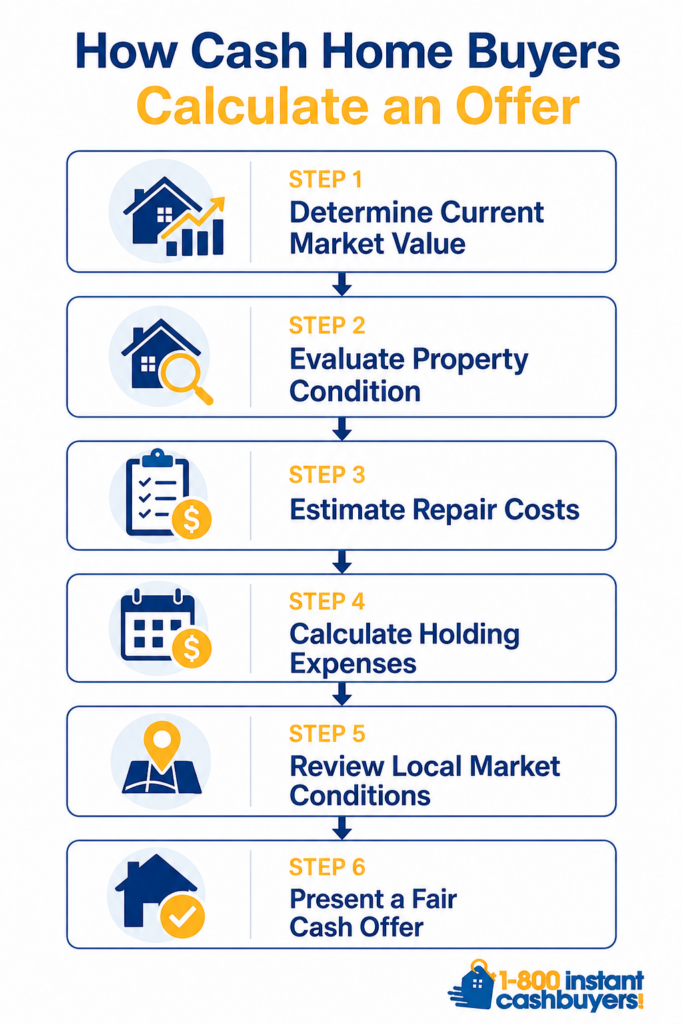
Although every investor has their own process, most professional cash home buyers evaluate many of the same core factors before presenting an offer.
1. Location and Neighborhood
The first thing buyers evaluate is where your property is located.
Even two similar homes can have very different values depending on their neighborhood.
Buyers often consider:
- School districts
- Crime rates
- Nearby amenities
- Employment opportunities
- Flood zones
- Future development
- Local housing demand
A home in a highly desirable neighborhood may receive stronger offers than a similar property in an area with slower demand.
Local market knowledge is one reason experienced buyers often provide more accurate valuations than companies unfamiliar with the area.
2. Recent Comparable Sales (“Comps”)
Comparable sales, commonly called comps, are one of the most important parts of determining a property’s value.
Cash buyers review recently sold homes that are similar in:
- Square footage
- Lot size
- Bedrooms
- Bathrooms
- Age
- Property condition
- Location
These recent sales help establish what buyers are currently willing to pay in today’s market.
Unlike online estimates, comparable sales are based on actual transactions rather than automated algorithms.
3. Current Property Condition
The condition of your property plays a significant role in determining your cash offer.
While many cash buyers purchase homes as-is, they still need to estimate how much work may be required before the property can be resold or rented.
Common repair items include:
- Roof replacement
- HVAC systems
- Plumbing
- Electrical systems
- Foundation issues
- Mold remediation
- Water damage
- Cosmetic updates
The more repairs a property requires, the more they may affect the final offer.
This doesn’t necessarily mean buyers are undervaluing your home—it simply reflects the costs they’ll likely incur after purchasing it.
4. Estimated Repair Costs
After evaluating the property’s condition, buyers estimate repair expenses.
For example:
| Repair | Estimated Cost Range |
|---|---|
| Interior Paint | $2,000–$6,000 |
| Roof Replacement | $10,000–$25,000 |
| HVAC Replacement | $5,000–$12,000 |
| Flooring | $4,000–$15,000 |
| Kitchen Remodel | $15,000–$40,000 |
| Foundation Repair | $5,000–$30,000+ |
These estimates vary depending on the property’s size, age, and local labor costs.
Professional buyers account for these projected expenses before making an offer.
5. Current Housing Market Conditions
Real estate markets change constantly.
A property may receive different offers depending on factors such as:
- Inventory levels
- Buyer demand
- Mortgage interest rates
- Seasonal market trends
- Local economic conditions
For example, during a strong seller’s market, buyers may be willing to offer more because homes are selling quickly.
During slower markets, investors may adjust offers to reflect increased holding risks.
6. Holding Costs
One factor many homeowners don’t realize is that buyers continue paying expenses after purchasing a property.
Holding costs may include:
- Property taxes
- Insurance
- Utilities
- Lawn maintenance
- HOA dues
- Financing costs
- Property management
- Routine maintenance
These ongoing expenses become part of the overall investment calculation.
7. Expected Resale or Rental Value
Finally, buyers estimate what the property may be worth after repairs or improvements.
Some companies purchase homes intending to renovate and resell them.
Others purchase homes to generate long-term rental income.
Because every company’s investment goals differ, this final step often explains why offers vary from one buyer to another.
Example: How a Cash Offer Is Calculated
Imagine a property with an estimated market value of $350,000.
A buyer determines the following:
| Item | Estimated Cost |
|---|---|
| Market Value | $350,000 |
| Roof Replacement | -$18,000 |
| Interior Repairs | -$12,000 |
| HVAC Replacement | -$7,000 |
| Closing Costs | -$4,000 |
| Holding Costs | -$9,000 |
| Investment Risk & Margin | -$30,000 |
Estimated Cash Offer: $270,000
At first glance, this may seem significantly lower than the home’s estimated market value.
However, once repair costs, carrying expenses, closing costs, and investment risk are factored in, the offer often reflects the total cost of purchasing and preparing the property for resale or rental—not just its current market price.
Once you’ve reviewed the offer and decided to move forward, understanding the cash home closing process can help you know what to expect between accepting the offer and receiving your proceeds.

Why Your Cash Offer May Be Different From Your Zestimate
One of the most common questions homeowners ask is:
“Why is my cash offer lower than my Zestimate?”
It’s a fair question, but it’s important to understand that a Zestimate and a cash offer are designed for different purposes.
A Zestimate is an automated estimate generated using publicly available data and computer algorithms. While it can provide a general idea of a home’s value, it doesn’t account for many of the details that influence a real purchase offer.
For example, a Zestimate usually cannot accurately evaluate:
- The condition of your roof
- Foundation issues
- Mold or water damage
- Outdated kitchens or bathrooms
- HVAC age
- Interior upgrades
- Deferred maintenance
Cash buyers, on the other hand, evaluate the actual condition of the property and estimate the costs required after purchasing it.
That doesn’t necessarily mean one number is “right” and the other is “wrong.” They simply serve different purposes.
Why Repair Costs Matter More Than Many Homeowners Realize
Even if a home looks well maintained, buyers often evaluate what improvements may be needed before they can resell or rent the property.
Some repairs have only a minor impact on value, while others significantly affect an investment.
| Repair Type | Typical Impact on Cash Offer |
|---|---|
| Interior Paint | Low |
| Landscaping | Low |
| Flooring Replacement | Moderate |
| HVAC System | Moderate |
| Roof Replacement | High |
| Plumbing Issues | High |
| Foundation Problems | Very High |
| Fire or Water Damage | Very High |
Many homeowners are surprised to learn that major structural repairs often influence an offer more than cosmetic improvements.
Cash Offer vs. Market Value: Understanding the Difference
Market value and a cash offer are related, but they are not the same thing.
Market Value is generally the estimated price a property might sell for on the open market after traditional marketing, showings, inspections, financing approvals, and negotiations.
A cash offer reflects what a buyer is willing to pay today while assuming the costs, risks, and responsibilities of purchasing the property as-is.
Think of it this way:
| Market Value Includes | Cash Offer Includes |
|---|---|
| Full retail price | Current property condition |
| Time spent on market | Estimated repair costs |
| Realtor marketing | Holding costs |
| Buyer financing | Investment risk |
| Negotiation period | Fast closing convenience |
Neither number is inherently better—they simply represent different selling approaches.
The Hidden Costs Cash Buyers Consider
When homeowners compare offers, they often focus only on the purchase price.
However, professional buyers also account for costs they’ll incur after closing.
These may include:
- Property taxes
- Homeowners insurance
- Utilities
- Lawn maintenance
- HOA dues
- Permit fees
- Contractor labor
- Material costs
- Property management
- Financing expenses
- Unexpected repairs
- Marketing costs if the property will be resold
These expenses are one reason two buyers may calculate different offers for the same home.
Should You Get More Than One Cash Offer?
In most situations, yes.
Comparing multiple offers allows homeowners to evaluate more than just the purchase price.
You can also compare:
- Closing timeline
- Flexibility
- Communication
- Reputation
- Proof of funds
- Experience
- Contract terms
- Customer reviews
Receiving multiple offers gives you a clearer understanding of the market and helps you choose the option that best fits your needs.
If you’re comparing companies, our guide on How to Compare Cash Home Buyers in Florida Without Getting Lowballed explains the questions every homeowner should ask before accepting an offer.

Ready to Find Out What Your Home May Be Worth?
Understanding how cash home buyers determine value can help you compare offers with greater confidence, but every property is unique. Factors like your home’s condition, location, local market demand, and repair needs all play a role in determining a fair cash offer.
If you’re thinking about selling, getting a no-obligation offer can give you a clearer picture of your options—whether you decide to sell now or simply want to understand your home’s current value.
At 1-800 Instant Cash Buyers, we purchase houses throughout Florida in as-is condition. There are no commissions, no repairs required, and no obligation to accept an offer. Our team will evaluate your property, explain how we arrived at the offer, and work with your preferred closing timeline.
Request your free, no-obligation cash offer today and discover what your home may be worth.
Call (407) 289-0151 or complete our online form to get started.
Additional Resources for Florida Homeowners
Selling a home is a significant financial decision, and understanding your options can help you make a more informed choice.
For additional educational information, these trusted organizations provide helpful homeowner resources:
- Consumer Financial Protection Bureau (CFPB) – Learn about mortgages, homeownership, and consumer financial protections.
- U.S. Department of Housing and Urban Development (HUD) – Explore homeowner education, housing assistance, and consumer resources.
- Florida Realtors® Market Statistics – Review statewide housing reports and current Florida real estate market trends.
Continue Your Research
If you’re exploring different home-selling situations, these related guides may also help:
- How to Compare Cash Home Buyers in Florida Without Getting Lowballed
- Sell My House Fast in Volusia County, FL
- Sell My House Fast in Seminole County, FL
- Sell My House Fast in Sarasota County, FL
- Sell My House Fast in Duval County, FL
- Sell My House Fast in Atlantic County, NJ
- Can You Sell a Water-Damaged House in Lee County, FL?
- Can You Sell a House With Liens in Broward County, FL?
Frequently Asked Questions
Why do different cash buyers offer different prices?
Every buyer has a unique business model, investment strategy, repair budget, and risk tolerance. These factors can result in different offers for the same property.
Why is my cash offer lower than my Zestimate?
A Zestimate is an automated estimate based on public data, while a cash offer reflects your home’s actual condition, repair costs, market demand, and the buyer’s anticipated expenses.
How do cash buyers determine my home’s value?
Most professional buyers evaluate comparable sales, property condition, estimated repairs, neighborhood demand, market trends, and holding costs before making an offer.
Can I negotiate a cash offer?
In many cases, yes. If you have additional information about your property or competing offers, some buyers may be willing to adjust their offer.
Should I get multiple cash offers?
Comparing multiple offers is generally recommended. It allows you to evaluate pricing, closing timelines, reputation, and overall transparency.
Do repairs always reduce a cash offer?
Not necessarily. Minor cosmetic repairs may have little effect, while major structural issues like foundation damage or roof replacement can significantly impact an offer.
Are cash buyers responsible for closing costs?
It depends on the company and the terms of the transaction. Always ask how closing costs will be handled before accepting an offer.
Is selling to a cash buyer faster than listing with a real estate agent?
In many cases, yes. Cash sales often close within days or weeks because they typically avoid mortgage financing contingencies.
Can I sell my house as-is?
Yes. Many professional cash home buyers purchase properties in their current condition without requiring repairs or renovations.
How long does a cash offer remain valid?
Offer expiration dates vary by company and market conditions. Always confirm the timeline before making a decision.